3. Since light has no mass how can it be trapped by the gravitational pull of a black hole?
Newton thought that only objects with mass could produce a gravitational force on each other. Applying Newton's theory of gravity, one would conclude that since light has no mass, the force of gravity couldn't affect it. Einstein discovered that the situation is a bit more complicated than that. First he discovered that gravity is produced by a curved space-time. Then Einstein theorized that the mass and radius of an object (its compactness) actually curves space-time. Mass is linked to space in a way that physicists today still do not completely understand. However, we know that the stronger the gravitational field of an object, the more the space around the object is curved. In other words, straight lines are no longer straight if exposed to a strong gravitational field; instead, they are curved. Since light ordinarily travels on a straight-line path, light follows a curved path if it passes through a strong gravitational field. This is what is meant by "curved space," and this is why light becomes trapped in a black hole. In the 1920's Sir Arthur Eddington proved Einstein's theory when he observed starlight curve when it traveled close to the Sun. This was the first successful prediction of Einstein's General Theory of Relativity.
One way to picture this effect of gravity is to imagine a piece of rubber sheeting stretched out. Imagine that you put a heavy ball in the center of the sheet. The weight of the ball will bend the surface of the sheet close to it. This is a two-dimensional picture of what gravity does to space in three dimensions. Now take a little marble and send it rolling from one side of the rubber sheet to the other. Instead of the marble taking a straight path to the other side of the sheet, it will follow the contour of the sheet that is curved by the weight of the ball in the center. This is similar to how the gravitation field created by an object (the ball) affects light (the marble)...JITU
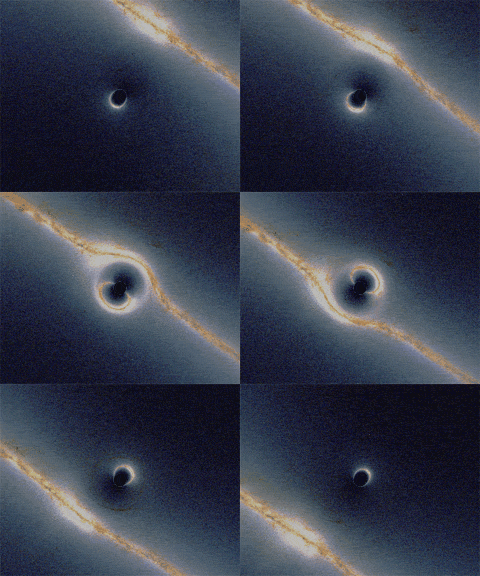
Even though a photon has a zero mass, it is still affected by gravity. In particular, we can see the effect of gravity on light in a phenomenon called "gravitational lensing," in which a massive object warps spacetime such that it bends light. Light passing through the gravitational lens can be bent such that the light takes multiple paths and we end up observing artifacts of this effect.
The first gravitational lens was discovered in 1979 even though Einstein predicted the effects of a gravitational lens in his general theory of relativity several decades earlier. In the case of the Twin Quasar, a galaxy between the star and ourselves acts as a gravitational lens and we end up with the observation of two identical objects in the sky.
Similarly, truly massive objects like black holes have escape velocities that exceed the speed of light. That is, their gravity is such that light cannot move away from the black hole's gravitational field.
What these examples illustrate is that photons, like everything else, follow the straightest possible path through spacetime, and when spacetime is warped or bent by massive objects, the photons adhere to this curvature. We often think of gravity affecting objects based on their mass, and since photons have 0 mass it seems counterintuitive to suggest that light is affected by gravity. There is still much to be learned about light and gravity, but for now we must conclude that light is affected by gravity, even if you consider conformity to spacetime curvature as "indirect" effect compared to, say, our gravitational attraction to the Earth.

Mukesh: Can light be attracted by gravity? If yes then please explain.
ReplyDelete3. Since light has no mass how can it be trapped by the gravitational pull of a black hole?
ReplyDeleteNewton thought that only objects with mass could produce a gravitational force on each other. Applying Newton's theory of gravity, one would conclude that since light has no mass, the force of gravity couldn't affect it. Einstein discovered that the situation is a bit more complicated than that. First he discovered that gravity is produced by a curved space-time. Then Einstein theorized that the mass and radius of an object (its compactness) actually curves space-time. Mass is linked to space in a way that physicists today still do not completely understand. However, we know that the stronger the gravitational field of an object, the more the space around the object is curved. In other words, straight lines are no longer straight if exposed to a strong gravitational field; instead, they are curved. Since light ordinarily travels on a straight-line path, light follows a curved path if it passes through a strong gravitational field. This is what is meant by "curved space," and this is why light becomes trapped in a black hole. In the 1920's Sir Arthur Eddington proved Einstein's theory when he observed starlight curve when it traveled close to the Sun. This was the first successful prediction of Einstein's General Theory of Relativity.
One way to picture this effect of gravity is to imagine a piece of rubber sheeting stretched out. Imagine that you put a heavy ball in the center of the sheet. The weight of the ball will bend the surface of the sheet close to it. This is a two-dimensional picture of what gravity does to space in three dimensions. Now take a little marble and send it rolling from one side of the rubber sheet to the other. Instead of the marble taking a straight path to the other side of the sheet, it will follow the contour of the sheet that is curved by the weight of the ball in the center. This is similar to how the gravitation field created by an object (the ball) affects light (the marble)...JITU
jitu
ReplyDeletewhat is grey matter???
whether higgs-boson particle..exist??? wat is the behind both thing???
Even though a photon has a zero mass, it is still affected by gravity. In particular, we can see the effect of gravity on light in a phenomenon called "gravitational lensing," in which a massive object warps spacetime such that it bends light. Light passing through the gravitational lens can be bent such that the light takes multiple paths and we end up observing artifacts of this effect.
ReplyDeleteThe first gravitational lens was discovered in 1979 even though Einstein predicted the effects of a gravitational lens in his general theory of relativity several decades earlier. In the case of the Twin Quasar, a galaxy between the star and ourselves acts as a gravitational lens and we end up with the observation of two identical objects in the sky.
Similarly, truly massive objects like black holes have escape velocities that exceed the speed of light. That is, their gravity is such that light cannot move away from the black hole's gravitational field.
What these examples illustrate is that photons, like everything else, follow the straightest possible path through spacetime, and when spacetime is warped or bent by massive objects, the photons adhere to this curvature. We often think of gravity affecting objects based on their mass, and since photons have 0 mass it seems counterintuitive to suggest that light is affected by gravity. There is still much to be learned about light and gravity, but for now we must conclude that light is affected by gravity, even if you consider conformity to spacetime curvature as "indirect" effect compared to, say, our gravitational attraction to the Earth.